I spent a full year running the ten-step Korean routine — every layer, every night — before I rebuilt my evenings around a much shorter, mask-led Chinese approach. Both live under the same "Asian skincare" umbrella and get compared to each other constantly, but they ask for genuinely different things from your evening. What follows is a comparison of structure, format, and pacing: how each routine is built and how it feels to run, not which one is "better," because that isn't a question a routine can settle for you.
Korean vs Chinese Skincare: Two Answers to One Question
The easiest way to understand the korean vs chinese skincare conversation is to stop treating them as rival product lines and start treating them as two scheduling philosophies. The Korean routine is a sequence — a fixed, ordered stack of light layers you apply one after another, each doing one small job. The Chinese approach, at least the clinical-mask side that Voolga comes out of, is a short targeted set where a single dressing-style mask anchors the whole evening and the steps around it are thin support.
They share more roots than the comparison usually admits. If you've read our piece on timeless Asian skin secrets, you've already met the common ground: both traditions treat the routine as a daily practice rather than an occasional fix. The difference is the shape of that practice — a long column of light layers, or a few heavier ones.
The 10-Step Korean Routine, Read as a Sequence
What people call the "10 step korean skincare routine" is a template, not a law. Plenty of people never run all ten on a weeknight; they run a core of five or six and add the rest on a Sunday. But the order is deliberate, and every step has a distinct format. Here's the sequence as I learned it, layer by layer.
1. Oil cleanse
A viscous oil or balm you massage onto dry skin. It spreads slick and heavy, doesn't foam, and turns milky when you add water before rinsing. This is the oily half of the double cleanse.
2. Water-based cleanse
The second half. A gel or cream cleanser applied to damp skin that foams up, then rinses clean. Format-wise it's the opposite of step one: lighter, lathering, and quick.
3. Exfoliant (a few nights a week)
A liquid or gel applied to a cotton pad or pressed in with the hands. It's a liquid format, not a scrub, and most people use it two or three nights a week rather than nightly.
4. Toner
In the Korean sequence a toner is a watery, hydrating liquid you pat in with your palms — no astringent sting. Format: thin, barely-there, and applied in several passes.
5. Essence
This is the step that confuses newcomers, because its name doesn't describe anything. An essence is a watery liquid slightly silkier than toner, patted in with the palms. Format: thin, silky, and easy to over-apply on a tired night.
6. Serum or ampoule
A more concentrated liquid in a smaller dose, usually from a dropper. Format: a thicker, more slip-prone liquid than the essence, and the first step where the layers start to sit on the skin rather than sink in.
7. Sheet mask
Fifteen to twenty minutes under a saturated fabric or fibre sheet. This is the step people picture when they say "Korean mask," but inside this routine it's one layer in a stack — sandwiched between serum and moisturiser, and often treated as an optional or weekend addition.
8. Eye cream
A denser cream tapped around the orbital bone in a very small dose. Format: thick, and the one product you use in a pea-sized amount rather than a palmful.
9. Moisturiser
A lotion or cream spread over everything that came before, as the final sealing layer of the evening. Format: cream, spread in light upward strokes.
10. SPF (mornings)
In a morning version of the sequence, the routine ends here — a lotion or fluid sunscreen applied generously and left as the top layer.
Run end to end, that's a twenty-to-thirty-minute evening on a full night. The formats are all light and all separate; the routine is long because the layers are thin.
The Chinese Approach: A Short, Targeted Set Built Around a Dressing Mask
If the Korean routine is a column of light layers, the chinese skincare approach — specifically the clinical-mask tradition Voolga comes out of — is closer to a short, structured set with one dressing mask at the centre. "Less is more" is the operating idea, and it shows up in the step count.
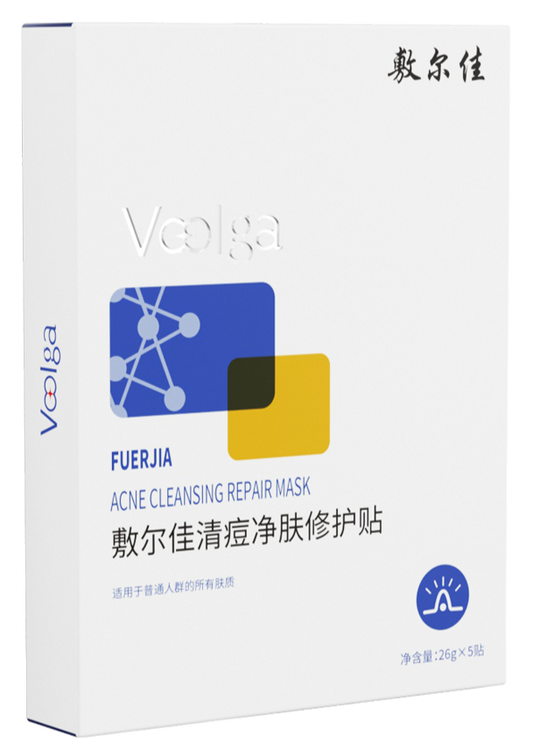
The heritage explains the format. Voolga's own story runs back to Fuerjia (敷尔佳) and a medical-dressing lineage: masks designed as dressings that sit on the skin for a set time, rather than a cosmetic extra appended to a long routine. That origin shapes how the approach is paced.
A typical evening looks like four moves, not ten:
- Cleanse. One step. A gel or cream cleanser, no oil phase needed unless you wore heavy sunscreen.
- Toner (optional). A quick watery pass, exactly as in the Korean routine — but here it's the only light layer, not the second of five.
- Dressing mask. The centre of the routine. A saturated sheet worn twenty to thirty minutes, often the longest single step of the evening.
- Moisturiser or cream. A short seal afterward, or none at all if the mask is worn last.
Where the Korean routine spreads its effort across many light products, the Chinese approach concentrates it into one or two. That's why the format of the mask itself is thicker and wetter than a mid-routine Korean sheet: it isn't layering over six other steps, so it carries more of the evening on its own.
The ingredient names are where the two traditions actually shake hands. A sodium hyaluronate dressing mask is built around the same humectant you'd find in a Korean essence, just delivered through a different format. A centella asiatica dressing mask leans on a botanical that shows up across both Chinese and Korean product shelves. Same vocabulary, different delivery.
Where the Sheet Mask Sits in Each Routine
This is the clearest structural difference between the two, and the one people get wrong. In the Korean sequence, a sheet mask is step seven — a mid-routine layer sandwiched between serum and moisturiser, and usually optional. In the Chinese dressing approach, the mask is the routine: it comes early, sits longest, and the steps around it are thin support rather than a stack.
Practically, that changes the pacing of the evening. A Korean sheet mask is a fifteen-minute pause you slot into a longer ritual and then continue past. A Chinese dressing mask is the main event — you settle in for it, and there's nothing much afterward. For the full walkthrough of ordering a mask against the rest of your products, our guide to where a sheet mask goes in your skincare routine covers the sequencing, and the sheet mask application techniques piece is worth reading before your first dressing-style mask — fit and wear time are what make the format work.
There's a third option if you like playing with structure: multi-masking, where you run more than one mask in a single session. It borrows from the Korean habit of adding layers and the Chinese habit of letting a mask sit as the main event, which makes it a useful bridge between the two.
Korean vs Chinese Skincare: The Two Routines Side by Side
Here's the comparison in one view — steps, formats, timing, and where the mask lands.
| Korean 10-step routine | Chinese-style dressing routine | |
|---|---|---|
| Typical number of steps | 5–10 (a core set plus weekend add-ons) | 3–4 |
| Signature format | Many thin liquids — oil, foam, toner, essence, serum | One saturated dressing sheet at the centre |
| Evening length | 20–30 minutes on a full night | 15–25 minutes, most of it mask wear time |
| Where the mask goes | Mid-routine, step 7, between serum and moisturiser | The centre of the routine, early and worn longest |
| Hero product category | Essences, serums, ampoules | Clinical dressing masks |
| Pacing | Layer by layer, in a fixed order | A few steps and one long sit |
| Price shape | Spread across many bottles | Concentrated into one or two masks |
| How it feels | Light layers building up over half an hour | A single heavier, wet sheet you settle in with |
Nothing in that table is about what either routine does to your skin — it's about how the two are assembled, how long they take, and what each one asks you to do with your hands and your time. That's the honest axis of comparison. Anyone who tells you one structure produces a certain result is comparing outcomes the formats can't promise.
How I Actually Switch Between the Two
My own pattern is seasonal and mood-driven rather than ideological. On a calm Sunday I'll run the long Korean sequence — the full double cleanse, the patting-in of toner and essence, the whole slow build — because the ceremony is half the point and I like the half hour of it. On a Tuesday after a late meeting, there's no version of me doing ten steps. That's a four-move Chinese-style evening: cleanse, a quick toner pass, a dressing mask for twenty minutes, done.
The switch isn't a compromise or a fallback. It's the same instincts running at two different speeds. When I want to handle my skin layer by layer, I run the long sequence. When I want one deliberate step and a shorter evening, I run the short set. Same person, same products shelf, different shape of night.
If you want to see how the traditions overlap before you pick a side, our look at why Chinese women still choose natural beauty products and the roundup of timeless Asian beauty secrets still used today both cover the shared habits better than any single routine breakdown can. When I restock the short-set side of my shelf, I usually start from the sheet mask collection and work outward to the full catalogue of Voolga masks.
Questions I Get Asked About the Two Routines
Do I have to run all ten steps to make the Korean routine "count"?
No. Most people run a core five or six nightly and add the exfoliant, sheet mask, and eye cream on the nights they have time. The ten-step version is a full template, not a minimum.
Do I have to choose one approach?
Not at all. Plenty of people run the long Korean sequence on weekends and a short dressing-mask set on weeknights. The two are compatible because they use the same ingredients in different formats — hydrating liquids in one, saturated sheets in the other.
Where does a sheet mask go in a Chinese-style routine?
Early and central. Unlike the Korean sequence, where it's step seven between serum and moisturiser, in the short dressing set the mask is the main step and everything else supports it.
How long does each routine actually take?
Plan on twenty to thirty minutes for a full Korean evening and fifteen to twenty-five for the Chinese-style set, most of which is mask wear time. The short set is shorter because there are fewer steps, not because any one step is rushed.
This article is for informational purposes about skincare products and ingredients. Voolga makes no claims about the health or medical effects of its products.