Why the Mask Format Matters as Much as the Ingredient
I've tried probably a dozen cica masks over the past two years, and I've learned something that surprised me: the format matters as much as the ingredient list. Two products can both list centella asiatica as a star ingredient, but if one is a lightweight hydrogel and the other is a non-woven dressing sheet, the experience — and how the formulation is delivered — is completely different.
Centella asiatica has become one of the most-requested ingredients in my skincare inbox. People want to know what to look for, how to choose between formats, and whether a "cica mask" is worth the hype. This is my deep dive into the face mask format specifically — not a general ingredient overview (I've covered centella's Asian beauty roots elsewhere), but a practical guide to the mask format.
What Is a Centella Asiatica Face Mask?
A centella asiatica face mask is a sheet, gel, or dressing mask that has centella asiatica extract (or its derivatives) as a primary ingredient. Centella asiatica — also known as cica, tiger grass, or gotu kola — is a plant native to Asia that has been used in traditional beauty practices for centuries. In modern skincare, it appears in everything from creams to toners to masks.
What makes the face mask format different from a centella cream or serum? It comes down to delivery. A cream or serum is designed to be absorbed quickly — you apply it, pat it in, and move on. A mask is designed for sustained contact. The formulation sits against the skin for 15–20 minutes, held in place by the mask substrate. That's a mechanical difference, not a chemical one — but it changes the experience significantly.
I think of it this way: a centella serum is a quick step in a routine. A centella mask is a dedicated moment. Both have their place, but they serve different purposes in how I approach my skincare.
Reading the Ingredient Label: Centella Extract vs. Madecassoside vs. Asiaticoside
Here's something that took me a while to figure out: "centella asiatica extract" on a label can mean several different things. The plant contains a group of compounds called triterpenoids, and the four main ones are:
- Madecassoside — one of the most concentrated active compounds in centella
- Asiaticoside — another major triterpenoid
- Madecassic acid — the free acid form
- Asiatic acid — another free acid form
When a product says "centella asiatica extract," it's using the whole-plant extract. When it says "madecassoside," it's using a purified compound. Neither is inherently better — whole-plant extracts contain a broader range of compounds, while purified compounds are more concentrated and specific. I personally look for products that list centella asiatica extract as one of the first few ingredients, which tells me it's present in a meaningful concentration, not just a token addition for the label.
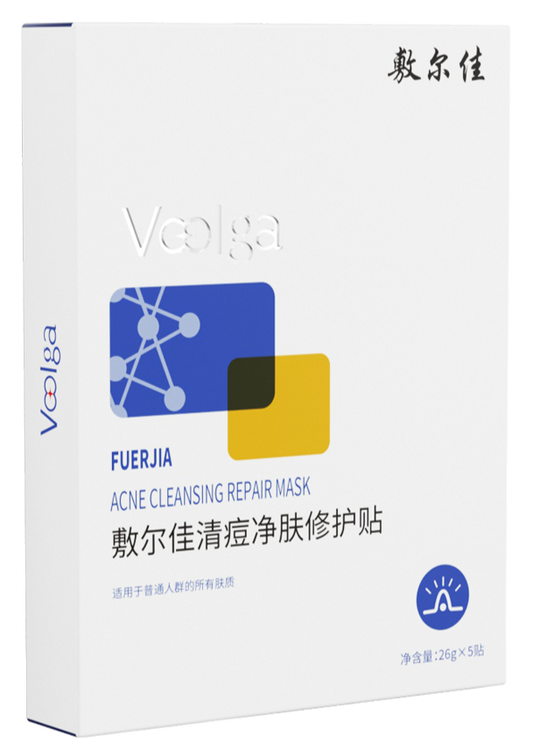
The Voolga Centella Asiatica Soothing and Repair Facial Mask uses centella asiatica extract in a dressing mask format. The label lists it prominently, and the product carries a Best Before date — which I see as a sign that the extract's stability has been tested and tracked, something I'd expect from a clinical-grade formulation rather than a mass-market mask.
What to Look For When Choosing a Cica Mask
After trying more cica masks than I care to count, here's my personal checklist:
- Where does centella sit on the ingredient list? If it's the first or second ingredient, the product is built around centella. If it's the fifteenth, it's a marketing add-on. I want it near the top.
- Is the formula fragrance-free? Fragrance can be a sensitizer, and if I'm reaching for a cica mask, I'm usually looking for something gentle. I prefer fragrance-free formulations.
- What's the mask substrate? Non-woven fabric, bio-cellulose, hydrogel, or cotton? Each has a different feel and fit. Non-woven fabric (used in dressing-style masks) tends to hold formulation well and conform closely to the face. Bio-cellulose is more expensive and has a gel-like feel. Hydrogel is cooling but can be slippery.
- Is it labeled as a "dressing" or a "cosmetic mask"? Dressing-format masks are modeled after medical dressing technology — the non-woven substrate, the pre-loaded formulation, the single-use format. Cosmetic masks are more traditional. Both are valid; I just like to know which I'm getting.
- Does it have a Best Before date? Plant extracts degrade over time. A Best Before date suggests the manufacturer has tested the extract's shelf life and isn't relying on a generic "good for 3 years" assumption.
Different Centella Mask Formats on the Market
Not all cica masks are created equal in format. Here are the main types I've encountered:
Non-Woven Dressing Masks
These are the format Voolga uses — a non-woven fabric sheet pre-loaded with formulation, modeled after medical dressing technology. The fabric conforms to the face and holds the essence against the skin. I find this format holds formulation better than cotton sheets, which can absorb some of the product into the fabric rather than delivering it to the skin. The Voolga Centella mask uses this format.
Bio-Cellulose Masks
Bio-cellulose is a fermented material (often coconut-derived) that forms a gel-like sheet. It adheres closely to the skin and has a distinctive "second skin" feel. These tend to be more expensive. The texture is smooth and slightly cooling. I like them for a more luxurious feel, though the formulation is what matters most.
Hydrogel Masks
Hydrogel masks are made of a water-based gel that holds its shape. They're inherently cooling and feel refreshing on application. The downside is that they can slide if you move around — I've lost more than one hydrogel mask to a sudden head tilt. I save these for lying-down-only masking sessions.
Clay or Wash-Off Masks with Centella
Some clay masks include centella extract alongside clay. These are a different experience entirely — you apply a paste, let it dry, and rinse off. I find them more involved than sheet masks and reserve them for days when I want a multi-step routine rather than a one-and-done moment.
How to Use a Centella Face Mask
Here's my personal masking protocol — purely mechanical, no medical claims, just how I do it:
- Cleanse first. A mask over uncleaned skin doesn't make sense to me. I want the formulation in contact with clean skin.
- Apply the sheet. I start at the forehead and smooth downward, pressing the non-woven fabric gently against the contours of my face. The cut-outs for eyes, nose, and mouth should align.
- Settle in for 15–20 minutes. This is the mask ritual — the 20 minutes of stillness. I don't try to do anything else. I sit, I breathe, I let the formulation sit.
- Remove and pat. After removing the sheet, I gently pat the remaining essence into my skin with my fingertips. There's usually a generous amount left on the skin surface.
- Storage tip: On warm evenings, I refrigerate the mask for 10 minutes before applying. The cool sheet against my face is my favorite part of the experience — pure sensory pleasure, nothing more.
If you're building a centella-focused routine, the Sensitive Skin Soothing collection has several products that pair well with the centella mask. I sometimes follow a centella mask with the Ectoin Night Repair Mask on a different evening — alternating rather than layering, to keep the experience fresh.
My Personal Take on Cica Masks
What I appreciate about centella masks is their versatility. A hyaluronic acid dressing mask is something I reach for when I want a straightforward hydration step. A centella mask is what I reach for when I want something that feels gentle and deliberate — a mask for evenings when I want the ritual to feel calm.
The texture of the centella essence tends to be lighter than a hyaluronic acid gel — more watery, less viscous. I find it absorbs quickly after I remove the sheet, leaving a comfortable, non-sticky finish. That's a sensory observation, not a claim about what it does for my skin.
If you want to explore the full range of mask formats, the sheet mask collection and the complete product catalog give you the full picture. My advice: try one format at a time, pay attention to the texture and the substrate, and see which feels right for your routine. There's no universally "best" cica mask — there's the one that fits your practice.
This article is for informational purposes about skincare products and ingredients. Voolga makes no claims about the health or medical effects of its products.