I always assumed the sheet mask was invented in a boardroom. A team sat down with a mood board somewhere, I figured, and decided that skincare should arrive on a piece of cloth. It didn't happen that way. What I found when I went looking for the sheet mask's history was not a product launch but a manufacturing trail: a run of industrial sheet materials, developed for medicine and clinical use long before anyone thought about faces, that eventually grew cheap enough and familiar enough to be cut into a face shape.
That trail is the story. I could not find a single inventor, and no patent starts the format. What exists instead is a set of material technologies with real dates, a naming habit that still shows up on labels today, and roughly thirty years of East Asian manufacturing that turned a clinical substrate into skincare's most recognisable packaging. This piece follows the product arc only: substrate, format, pouch, naming. The ingredient side of beauty history is a different story, and we told it separately in Timeless Beauty: Historical Natural Products That Still Work Wonders Today.
By the Voolga team · Updated October 5, 2026
Clinical dressing materials came first
Start with the word, because the word is where the whole thing begins. A dressing, in manufacturing vocabulary, is a sheet of material prepared to be applied to a surface. The clinical dressing industry spent the middle of the twentieth century industrialising exactly that idea, and in doing so it built the material supply chain the sheet mask would later borrow: bonded nonwovens, polymer films, hydrocolloid sheets, hydrogels. Bonded nonwovens scaled from the 1940s and 1950s onward, and spunlace, the hydroentangling process behind the soft cotton-feeling substrates most sheet masks use today, was commercialised in the 1960s and 1970s. A bond is what separates a nonwoven from a woven fabric: the fibres are held together by mechanical, thermal, or chemical means instead of being woven or knitted (encyclopedia entry on nonwoven fabric).
None of that had anything to do with faces. It was material engineering, and what it produced were three things the sheet mask needed: a thin, uniform sheet that could be cut and folded; a hygienic single-use sachet; and the vocabulary. Once you have spent decades making flat sheets by the million, sealing them individually in foil, and stamping a batch code on the front, the remaining step to putting one on a face is a marketing decision rather than an engineering one.
Why "dressing" still shows up on some labels
The naming is the clearest fossil the format left behind. In the Chinese market, where a great deal of this manufacturing sits, the registration vocabulary splits along two pathways: a mask sold as a cosmetic carries the mask word, while a product that travels the medical-material route carries the dressing word. Two products can look almost identical on a shelf and still use different nouns on the front of the box, because they came through different paperwork.
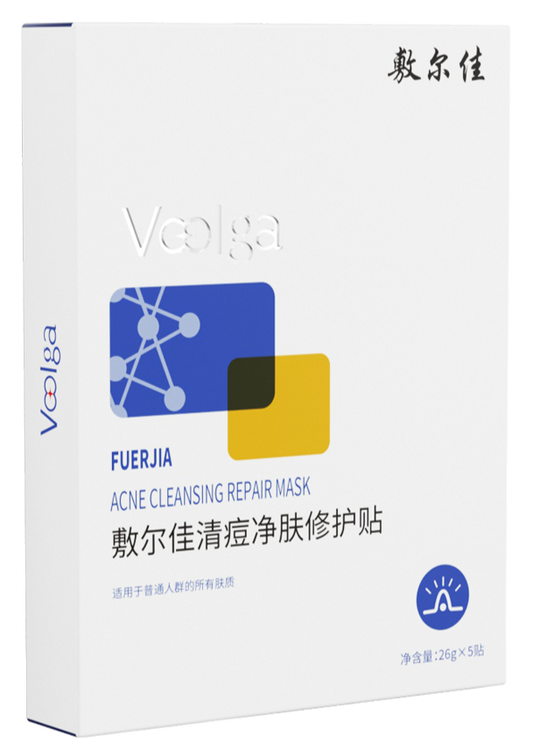
Voolga's own mask names keep the dressing word, and the sodium hyaluronate dressing mask is the clearest example. That is a naming inheritance from the material lineage, not a description of what a product does. We wrote the longer version of that distinction in medical-grade sheet masks vs regular sheet masks, if labels are what you care about.
The earliest modern sheet masks
The first saturated sheets sold as beauty products appear in the 1990s in East Asia, and honest history has to admit the attribution is contested. Japanese manufacturers are usually credited with the earliest mass-market versions, and the format grew directly out of older applied "pack" masks that were spread on and rinsed off; the whole family tree is mapped in our guide to every mask format. Korean manufacturers then took the same material and industrialised it through the late 1990s and 2000s: lower unit cost, far bigger runs, and a sheet meant to be used as routine rather than saved for special occasions.
Do not picture a good fit. The early versions were flat nonwoven rectangles with an approximate face cut into them: two eye holes, a mouth, no slits, no nose flap, no contour. They were folded into a foil sachet with a small reservoir of liquid pooled at the bottom. The sizing was a compromise that favoured the die cutter rather than the wearer, and the sheets were thin enough to dry out before the twenty minutes were up.
What those first masks did have was the commercial idea the format has never given up: one sealed, single-use session, a few dollars, no technique, no rinsing.
How K-beauty carried the format worldwide
Between the late 1990s and the mid-2010s, Korean manufacturers did for the sheet mask what they did for a dozen other formats in the category. They made it cheap, they made it everywhere, and they exported the vocabulary that came with it, words like essence included. Korean cosmetics exports grew through the 2000s and then climbed sharply in the 2010s, and the sheet mask rode the wave as the cheapest entry product in the market.
Soko Glam, founded in 2012, was among the first US shops to sell K-beauty by curation rather than by import aisle. Glow Recipe, founded in 2014, followed a similar path into mainstream retail. By the middle of the 2010s sheet masks were in American drugstores, and the ten-step routine had become a magazine staple. The mask was the step everyone could actually do, because it required no skill: open the pouch, lay it down, wait.
That is also how the format picked up its cultural furniture — the flight mask, the hotel-room photo, the multi-pack bought as a gift. Older heritage practices sat alongside it, and we've written about the rice-water tradition separately, but the sheet mask itself was a manufactured product from its first day and never pretended otherwise. A flat foil sachet ships like a book, spills nothing, and stacks in a drawer. A jar of saturated sheets could never have done that.
The substrate changed four times, and that is the real history
Sheet mask history in one line: the shape stayed the same and the material under it kept changing. Four substrate families, each from a different manufacturing tradition.
- Nonwoven. The original. Fibres bonded into a sheet — viscose, cotton blends, later cupra — cheap to cut and easy to saturate. Spunlace bonding gave it the soft hand-feel.
- Hydrogel. A cast polymer gel rather than a fabric: a cross-linked gel sheet, sometimes formed on a mesh carrier, sometimes clear enough to be printed. Thicker and cooler in the hand than nonwoven, and not fibrous at all.
- Bio-cellulose. Fermented cellulose grown into a sheet by acetic-acid bacteria. The material already existed as a clinical dressing before cosmetics adopted it, and its fine fibre structure is why this substrate feels the closest to skin. Our materials comparison covers how to tell them apart by touch.
- Dressing formats. Masks that come through the medical-material pathway and keep the dressing word on the label, such as a recombinant Type III collagen dressing. The most direct descendant of the clinical side of the family.
| Substrate | How it is made | Feel | Approximate arrival in the beauty format |
|---|---|---|---|
| Nonwoven | Fibres bonded by spunlace | Cotton-like, holds a liquid load | 1990s |
| Hydrogel | Gel cast in a mould, sometimes on a mesh carrier | Thick, cool, slick | 2000s |
| Bio-cellulose | Bacterial fermentation grown into a sheet | Dense, very fine fibre | Late 2000s onward |
| Dressing format | Medical-material lineage, dated batch printing | Varies | Present throughout |
Every one of those changes came from outside cosmetics: spunlace from industrial textiles, hydrogel from polymer chemistry, bio-cellulose from fermentation and medicine. Cosmetics has been the borrower in this story from start to finish.
Why the modern pouch looks the way it does
The pouch is the piece of engineering nobody thinks about, and it explains half of how the format works as a product. Open the top of a sealed mask sachet and you are looking at a layered structure: a printed outer film, an aluminium barrier layer, and an inner heat-seal layer that bonds to itself when the machine closes the pouch. The metal layer is there for shelf life: it keeps light, air and moisture away from the sheet so the product stays saturated on a peg hook for two years rather than two weeks.
Everything else on the sachet is a solved problem from another industry. The serrated notch at the top is a pre-cut tear line, so no scissors are needed. The flat rectangle is the cheapest shape to stack, carton, hang and mail. The pool of liquid at the bottom, the "extra essence" people squeeze out, is what is left after the substrate takes up its load. Some converters flush the headspace with nitrogen before sealing to push oxygen out. And the batch or best-before stamp on the back comes from the medical-material side of the family, where dating a sealed product is standard practice. Voolga's pouches print one, which is why we wrote the guide to reading a best-before label.
The sachet is also the reason a sheet mask can be cheap. A jar of saturated sheets is a packaging problem: the top layer dries, the liquid at the rim starts to turn, and the format stops being hygienic. A sealed sachet is one sheet, one dose, one date, produced by a form-fill-seal machine that has been running in food and medical packaging for decades.
What the history is worth when you are holding a pouch
Two habits fall out of all of this. First, read the substrate word on the front before the marketing words. Nonwoven, hydrogel, bio-cellulose and dressing are manufacturing terms with separate origins, and they tell you what is in your hand more reliably than any adjective printed next to them. Second, read the date and the ingredient list, because a saturated sheet is a liquid product inside a shelf-life package; our ingredient-list guide covers the ordering convention on the back of the pouch.
The history is also a decent antidote to marketing. A sheet mask is not a recent invention of modern skincare science, and it is not an ancient ritual either. It is an industrial material that was manufactured for other purposes first, got cheap, and found a second life on a face. I find that more interesting than a founding myth.
To see how far the material lineage reaches in a modern line, the sheet mask collection holds the dressing-word products, and the full Voolga lineup covers the rest of the formats.
Questions about sheet mask history
Who invented the sheet mask?
No single inventor is documented. The format grew out of clinical dressing materials — nonwovens, hydrogels, fermented cellulose — rather than being designed from scratch. The earliest mass-market saturated sheets appeared in East Asia in the 1990s, with Japanese manufacturers usually credited for the first versions and Korean manufacturers credited with industrialising and exporting the format.
Why is it called a dressing?
Because dressing is the manufacturing word for a prepared sheet of material. In the Chinese market the term also marks which registration pathway a product came through, so two similar-looking products can carry different nouns on the front. Voolga's product names keep the dressing word as part of that naming inheritance.
How long has the sheet mask been around?
Two answers, depending on where you start counting. The materials go back to the middle of the twentieth century, when bonded nonwovens and clinical sheet dressings were industrialised. The beauty format itself is about three decades old, dating to the 1990s, and it has been a global retail staple since the 2010s.
Were sheet masks always made of nonwoven fabric?
No. Nonwoven was first and is still the most common substrate, but the format has since borrowed hydrogel, a cast polymer gel; bio-cellulose, fermented cellulose grown into a sheet; and materials from the dressing pathway. Every one of those came from outside cosmetics before it appeared as a face-shaped sheet.
This article is for informational purposes about skincare products and ingredients. Voolga makes no claims about the health or medical effects of its products.